
Siga @tucuman.art nas Redes

This article is an in-depth follow-up to our carousel “5 Steps to Publishing an Ebook,” published on Tucuman’s Instagram. If you made it here from Instagram, this is your chance to go a little beyond those five steps.
For many people, writing a book or turning an idea into a publication can feel like a distant dream. For a long time, the publishing industry was strongly associated with major publishing houses and the need to convince someone that your story or project was worth publishing.
That has changed.
The growth of digital books, e-readers, and self-publishing platforms has created new opportunities for independent writers, businesses, experts, and content creators who want to turn an idea into a publication.
But publishing an ebook doesn’t simply mean turning a text file into a digital book, or exporting a PDF and uploading it somewhere online.
Just as with a physical book, you need to think about the project as a whole: what is its purpose, who is your audience, how will they consume the content, and where do they expect to find it?
Define Your Purpose
An ebook can have many different purposes. And the first step in turning an idea into a publication is understanding why you are publishing it in the first place.
Knowing the purpose of your work from the beginning provides a foundation for every stage that follows. This helps eliminate paths that would not add value to the project and, most importantly, avoid processes that may be more time-consuming, expensive, or inefficient than necessary.
An independent novel, for example, has very different needs from a technical ebook designed to complement a course. A guide might be created as free material for lead generation, while a catalog or portfolio might primarily serve to showcase a product or service.
So, before thinking about the cover, platform, or price, ask yourself:
What do I want this ebook to do?
If it is intended for entertainment, general reading, or as an extension of a physical book, that will have a direct impact on the format and distribution channels you choose.
If it is supporting material, a guide, a portfolio, or a marketing tool, other solutions may make more sense.
The purpose comes first. Every decision that follows should work toward it.
EPUB oR PDF?
The Format Depends on the Reading Experience
Once the objective is defined, we arrive at one of the most important decisions in the project: how will this content be presented to the reader?
Your text can be excellent. Your idea can be original. But the way all of that reaches your audience matters too.
Yes, design matters.
And design isn’t simply about beauty. Beauty is an aesthetic question and, like any aesthetic question, it can be subjective. Design is about bringing aesthetics, function, and usability together.
A good ebook should be designed so that readers can consume its content in the way that works best for them.
And that starts with choosing the right format.
If the project is heavily dependent on visual elements — such as a portfolio, catalog, institutional publication, or a work made up of illustrations, graphics, and elements positioned in a specific way — PDF can be an interesting solution, especially when preserving the exact composition created by the designer is important.
There are also fixed-layout EPUB formats that can work for some of these projects, but their support and behavior can vary between platforms and devices. That is why the choice should consider not only how the file was created, but where and how it will be read.
For predominantly text-based narratives, such as novels, short stories, or prose-based nonfiction, EPUB will usually provide a more suitable reading experience.
That’s because EPUB is a reflowable format. In other words, the content can adapt to the size of the screen and the reader’s device settings. Readers can, for example, change the font size, choose a different typeface, or adjust other display settings available on their app or e-reader to make the reading experience more comfortable and familiar to them.
That freedom is one of the great advantages of digital reading.
And yes, perhaps that’s a little frustrating for you sitting there thinking about how many hours you spent choosing that font, adjusting every detail, and creating an entire identity for your book… only for the reader to go ahead and replace it with something else.
But there is an important caveat: the fact that readers can personalize their experience doesn’t mean that the author or publisher shouldn’t think about that experience.
Choosing an appropriate typeface, establishing visual hierarchy, defining spacing, and building an identity for the book are still important decisions.
The personalization may be in the reader’s hands, but the care behind the experience should begin with the person publishing the book.
A digital work should not be treated as a simple text file.
It is a publication.
And every one of these choices helps shape the reader’s perception of the care and quality behind the project.
Think About the Cover for Digital
People judge a book by its cover. I’m sorry if that sounds unfair, but it’s one of those hard truths to hear. And there’s a reason for it.
The cover is often the first contact someone has with a book. Before reading the synopsis, a single page, or even the full title, the reader will probably see a small image on their screen. And in the digital environment, that creates an additional challenge: the cover needs to work at very different sizes. It may appear as a small thumbnail in an online bookstore, a digital library, a recommendation, an advertisement, or on a phone screen.
That’s why a good digital cover shouldn’t be designed simply as a beautiful image. It needs to be recognizable, legible, and consistent with the identity of the book.
Once again, design isn’t just about beauty, remember? A composition can be visually interesting and still fail to communicate. The title needs to remain legible as a thumbnail. The typeface should work with the genre and identity of the book. Proportions, information hierarchy, and contrast between elements all need to work at different sizes.
And the same goes for color.
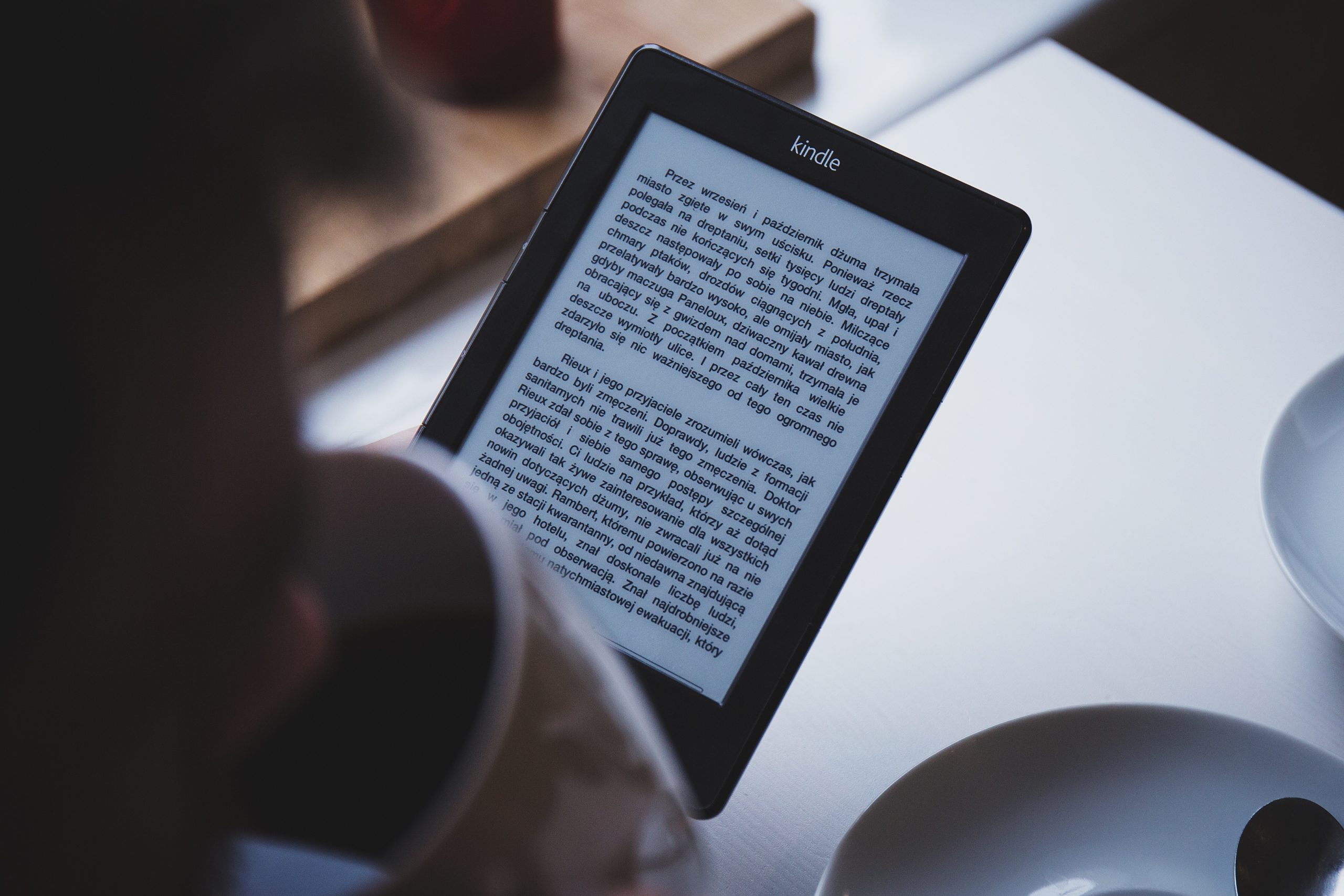
In the digital environment, a cover may be viewed on different screens, apps, and under different lighting conditions. And there’s one detail that many people only discover after publishing: some of the most popular reading devices, such as the Kindle, use black-and-white screens.
This means that a color combination that works perfectly on your computer screen can lose all of its contrast when converted to grayscale. That title that looked perfectly legible over the image may simply disappear.
So it’s not enough to think about how the cover will look on a large, full-color screen. You also need to consider how it will look when reduced to a small thumbnail and when viewed on a monochrome display.
Always remember: the cover is often responsible for carrying a large part of a book’s visual identity. It needs to communicate something before the reader even knows the story.
Meet Your Reader Where They Are
Imagine you’ve done all of this. The text is ready. The file has been properly developed. The cover is finished. The publication is ready to go.
Now it’s time to decide where to sell it. A major platform such as Amazon may seem like the obvious choice. After all, millions of people are already there looking for books.
But the most important question isn’t: “What is the biggest platform?” It’s: “Where is my reader?”
Imagine, for example, a technical ebook that essentially works as a course. Depending on the audience and business model, a platform focused on courses and digital products might make more sense than a major digital bookstore.
In other cases, a dedicated landing page can be an important tool for presenting the project, capturing leads, and building a direct relationship with your audience.
For an independent author releasing their first novel, however, the situation may be different.
A landing page can be an excellent way to present the book, its story, and its universe. But turning it into the main sales channel can require much more effort in terms of promotion, payments, distribution, and managing the reading experience.
In that case, a self-publishing platform can provide infrastructure that would be difficult — and often expensive — to reproduce independently.
The important thing to understand is that publishing and distribution are two different decisions.
Your ebook can have its own landing page, a listing on a digital bookstore, and several different promotional strategies. One doesn’t necessarily exclude the other.
Once again, the best solution depends on the purpose you defined at the beginning of the project.
So, Where Do You Start?
In the end, publishing an ebook can seem much more complicated than simply putting a file online. And, in a way, it is. But that doesn’t have to be a reason to give up.
Once you understand that an ebook is a publication — not simply a digital file — it becomes easier to make each decision: define the objective, choose the format, think about the reading experience, develop a visual identity, create an appropriate cover, and find the channels where your audience is actually looking. The most important thing is to start.
You don’t need to have every answer before taking the first step. But you do need to understand that every decision made throughout the development of an ebook influences the experience your reader will have with your work.
Transforme sua ideia em uma publicação
At Tucuman, we believe an ebook deserves to be treated as a complete editorial project.
From file development to adaptation for different formats and platforms, we can help you turn your content into a digital publication designed around your audience and the purpose of your work.
If you already have a manuscript, technical material, catalog, guide, or simply an idea you would like to turn into an ebook, get in touch with our team.
Your idea already exists. Now, let’s take it off the page and turn it into a publication. Get in touch with us.

Camila Vollger
Creative Director e Co-fundadora da Tucuman, Camila Vollger é formada em Publicidade e Propaganda, com especialização em Produção Audiovisual. Sua atuação transita por diferentes campos da criação, construindo um olhar multidisciplinar e atento às particularidades de cada projeto.